
Your CMO is pushing agencies to create better ads and acquire more subscribers.
Your CFO is watching processing costs.
Your CIO is protecting uptime.
Your retention team is trying to reduce churn.
Your CEO is holding everyone accountable through the company dashboard.
Every one of those responsibilities matters.
But none necessarily includes optimizing the complete journey between a customer attempting to pay and the company successfully retaining the revenue.
That is how payment leaks become accepted as “the cost of doing business.”
The systems appear to be working.
Payments are processed. Revenue arrives. Retry emails are sent. Chargebacks remain within a familiar range.
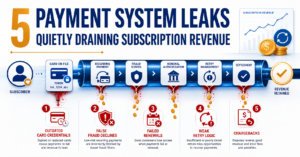
Meanwhile, legitimate buyers are rejected at checkout, long-term subscribers are canceled by outdated credentials, healthy renewals are mistaken for fraud, aggressive retries create additional declines, and preventable disputes become chargebacks.
At lower volume, these losses can seem manageable.
As recurring revenue grows, the same leaks can quietly drain ARR, weaken lifetime value, inflate CAC, and force Marketing to replace customers the company never should have lost.
Here are five recognizable symptoms that suggest payment performance may be suppressing your subscription growth.
1. Customers Who Decided to Buy Are Disappearing at the Payment Screen
The first payment is where customer intent becomes revenue.
The prospect has already:
- Responded to the advertising
- Visited the site
- Considered the offer
- Selected a plan
- Entered payment information
- Clicked the final button
Marketing has done almost everything required to acquire the customer.
Then the issuing bank declines the transaction.
Many companies treat that result as ordinary checkout abandonment, suspected fraud, or a problem the customer should resolve by calling support.
But some of those people have valid cards, available credit, and a genuine desire to buy.
They did not reject your offer.
The payment system rejected them.
Payment experts report that more than half of failed payments for first time buyers may involve legitimate transactions rejected by issuer fraud systems.
Symptoms your team may recognize
- Customers report that valid cards are being declined.
- The same card succeeds on a second attempt.
- Buyers complete the purchase after switching devices or payment methods.
- Checkout starts increase without a similar increase in paid subscriptions.
- First-payment approval varies by geography, card type, device, or issuing bank.
- “Do not honor” and other vague decline codes appear frequently.
- Fraud-related declines increase without a similar rise in confirmed fraud.
- Paid channels appear less profitable even though buyer engagement remains strong.
- Customer service hears from people who wanted to subscribe but could not complete payment.
- The marketing dashboard reports checkout conversion but not first-attempt authorization.
Why the CMO should care
Payment declines reduce the number of customers produced by the same advertising investment.
That inflates CAC and suppresses ROAS without any change in the ad, audience, landing page, or offer.
A marketing channel that appears unprofitable at an 88% authorization rate may become attractive at 91% or 92%. Getting payments systems fixed can become a competitive advantage.
Leave your competitors endlessly improving creative while ignoring the final conversion point.
The question to ask
What percentage of first-payment attempts are approved, and how does that rate change by campaign, device, geography, card network, payment method, and issuing bank?
If the answer is not immediately available, payment performance is missing from the marketing funnel.
2. Loyal Subscribers Are Being Canceled By Outdated Systems
A subscriber can remain happy, intend to renew, and have money available—yet still be canceled because the payment information stored by the company is no longer current.
The customer did not churn.
The credential did.
Cards expire. They are replaced after suspected fraud. They are reissued after being lost or stolen. Banks update account details.
The customer rarely thinks:
“I should update every subscription connected to my old card.”
The subscription company attempts the renewal using outdated information.
The payment fails.
Retries begin.
An email asks the customer to update a card they may not realize has changed inside the payment system.
If they do not respond, the subscription lapses.
Worldpay’s credential-management materials report that 30% of credit cards are reissued annually and that recurring-card payments experience meaningful decline rates, although not every recurring decline is caused by an outdated credential. The materials describe account updater services and network tokens as ways to keep credentials current and prevent avoidable subscription lapses.
Symptoms your team may recognize
- Renewal failures are elevated among established subscribers.
- Customers say their cards are valid after receiving a payment-failure notice.
- A payment succeeds after the customer manually re-enters the card.
- Failures are concentrated among expired, replaced, or reissued cards.
- Renewal performance differs by card network, gateway, or processor.
- A meaningful percentage of customers never respond to card-update emails.
- Customer service repeatedly restores accounts after payment details are refreshed.
- The business cannot state what percentage of recurring credentials use network tokens.
- No one knows how many stored credentials receive automatic issuer updates.
- Failed-payment reporting does not include credential health.
Why the CMO should care
These are not marginal customers.
A subscriber who has stayed for twelve months, twenty-four months, or longer has already demonstrated value and commitment.
The company paid to acquire them.
The product earned their continued loyalty.
Then an outdated payment identity ended the relationship.
Marketing must now spend money replacing a high-LTV subscriber who never intended to leave.
The question to ask
What percentage of failed renewals are caused by expired, replaced, or outdated credentials—and how many of those customers are permanently lost?
The next question is even more revealing:
What percentage of our recurring credentials are protected by account updater services or network tokens?
3. Issuing Banks Are Mistaking Your Best Subscribers for Fraud
This leak looks similar to an outdated credential failure, but the cause is different.
The card information may be completely correct.
The subscriber may have:
- Paid successfully for two years
- Never disputed a transaction
- Used the product regularly
- Renewed at the same price before
- Enough available credit
- Every intention of remaining subscribed
Your company knows this is a valuable, low-risk customer.
The issuing bank may not.
The issuer has milliseconds to decide whether to approve the renewal. It sees the data included with the authorization request, its own account history, merchant behavior, classification, transaction patterns, and fraud models.
If the transaction is presented with weak, incomplete, outdated, or poorly structured signals, the issuer may not recognize the trusted customer relationship your company sees.
When the bank is uncertain, it may decline.
Why the decline code may mislead you
The response may say:
- Insufficient funds
- Do not honor
- Suspected fraud
- Generic decline
- Transaction not permitted
Those descriptions often tell only part of the story.
“Suspected fraud” does not necessarily mean the customer committed fraud. It may mean the issuer did not receive enough evidence to approve confidently.
“Do not honor” tells the merchant the transaction was rejected without explaining why.
Some false declines may even be hidden within categories the team assumes are straightforward. Often, legitimate transactions are buried inside vague issuer responses and notes that decline reporting can collapse several risk signals into one unhelpful code.
The team concludes:
“The customer ran out of money.”
The customer experiences:
“My card works everywhere else. What’s wrong with them that they can’t get it to go through?”
Symptoms your team may recognize
- Long-term subscribers receive unexplained renewal declines.
- Customers insist their cards are valid.
- A failed payment succeeds later using the same card.
- Some issuing banks decline far more renewals than others.
- Approval rates differ sharply by issuer or card network.
- “Do not honor” is one of the most common responses.
- Suspected-fraud declines rise while customer quality remains stable.
- Failed-payment rates increase as transaction volume grows.
- Previously reliable subscribers suddenly disappear.
- The company cannot explain why particular issuers reject known customers.
- Approval rates are deteriorating even though pricing, traffic quality, and customer behavior have not materially changed.
Why the CMO should care
The business may classify these subscribers as financially weak, risky, or likely to churn.
That can lead Marketing to make the wrong decisions about:
- Customer quality
- Pricing
- Acquisition channels
- Geographies
- Audience segments
- Allowable CAC
The real issue may be how the transaction is being interpreted by the issuing bank.
The question to ask
How many failed renewals involve established customers with valid credentials, prior successful payments, and vague or risk-related decline codes?
Then ask:
Which issuing banks are responsible for the largest share of those declines?
This is the group hidden inside the payment reports:
Customers who could pay, wanted to stay, and should have been approved—but were not.
4. Your Recovery System Is Creating More Declines
Most subscription companies believe failed-payment recovery is handled.
A recurring payment fails.
The billing system retries the card.
An email asks the customer to update their payment information.
A more advanced company may add text messages or outbound calls.
All of those can be useful.
But the existence of a recovery process does not mean the process is optimized.
Not every failed payment should receive the same treatment.
Retrying insufficient funds is different from retrying an expired credential.
Retrying an expired credential is different from retrying a transaction rejected because of suspected fraud.
Repeatedly submitting the wrong transaction can affect how issuers view your company as a fraud risk.
Even if you do recover more dollars in the short term “set it and forget it” practices can quietly weaken future approval performance.
How the decline spiral develops
- A recurring payment fails.
- The same transaction is resubmitted automatically.
- The issuer sees repeated unsuccessful attempts.
- The merchant begins to appear riskier.
- More legitimate payments are declined.
- The recovery system generates even more retries.
- Recovery efficiency falls.
- The team adds more retries, emails, and calls.
The treatment begins intensifying the condition.
Many credit card issuers consider retry frequency, total declines, and the kinds of failed transactions repeatedly submitted when assessing merchant behavior.
Symptoms your team may recognize
- Every failed payment receives the same retry sequence.
- Retry timing does not change by decline reason.
- The number of attempts per failed customer is increasing.
- Recovered dollars are increasing while the recovery percentage is flat or falling.
- First-attempt approval rates are gradually deteriorating.
- “Do not honor” and suspected-fraud responses are becoming more common.
- Certain issuers show worsening approval performance.
- More customers enter the recovery sequence every month.
- Hard declines are repeatedly resubmitted.
- The team cannot identify which retry attempt creates most recoveries.
- Failed-payment recovery is not compared with an outside benchmark.
- The dashboard reports recovered dollars without reporting permanent subscriber losses.
- More emails and calls are required to recover the same amount of revenue.
Why the CMO should care
“Recovered $500,000” sounds positive. Even, we increased recovered transactions from $500,000 to $800,000 sounds like a massive win.
But those numbers are incomplete if:
- Failed payment volume rose from $700,000 to $1.5 million
- First-attempt approval declined
- More high-LTV customers were permanently lost
- Issuer confidence weakened
- Recovery cost increased
The critical measure is not gross recovered dollars.
It is profitable customer value retained without damaging future approval performance.
The question to ask
Do retries change according to decline reason, issuer response, timing, customer history, and probability of recovery?
Then ask:
Is first-attempt approval improving or deteriorating while recovery activity increases?
A recovery system can be collecting money while making the overall payment environment worse.
5. Chargebacks Are Being Treated as a Cost of Doing Business
A successful authorization does not guarantee the company keeps the revenue.
Weeks later, the cardholder may open a banking app and select:
“I don’t recognize this charge.”
The merchant often treats the resulting chargeback as the beginning of the problem.
It may actually be the end of several missed opportunities.
At the inquiry stage, the issuing bank may be trying to identify the transaction for the customer.
If the merchant can immediately provide clear information—such as the recognized brand name, product, order, subscription details, customer email, device, IP address, and prior relationship—the bank may be able to resolve the inquiry before it becomes an alert, refund, fraud report, or formal chargeback.
This is called a pre-alert deflection: transaction data is sent to the issuing bank in real time so the inquiry can potentially be resolved before the damage occurs.
Why timing matters
There are three distinct outcomes:
Before an alert:
The customer recognizes the transaction. The sale may be retained. There is no refund or chargeback.
After an alert:
A refund may stop the chargeback, but the sale is still lost.
After a chargeback:
The merchant may fight the case and recover funds, but the revenue has already been removed and administrative costs have been incurred.
Avoiding a chargeback is not always the same as saving the sale.
Meanwhile, companies with pre-alert technology can resolve a portion of eligible disputes before escalation. Deeper merchant, CRM, cart, product, device, and network data as improving the context available to the issuer.
Symptoms your team may recognize
- Chargebacks are reported only as a total percentage.
- Preventable causes are not categorized.
- Customers contact their bank before contacting your company.
- The billing descriptor differs from the brand customers recognize.
- Finance, Fraud, Customer Service, and Retention maintain different reports.
- Alerts are automatically refunded without measuring whether the sale could have been saved.
- Chargebacks are not traced back to acquisition source, offer, or campaign.
- Leadership cannot see fraud reports and formal disputes together.
- VAMP is discussed only after the processor raises a concern.
- Different merchant accounts show very different dispute performance.
- Reserves or processing limits appear without leadership understanding what caused them.
- The business counts the reversed sale but not the fee, fulfillment cost, staff time, or future LTV lost.
- The team fights chargebacks after they occur but does little during the original inquiry.
Why the CMO should care
A campaign may appear profitable when the sale occurs.
Weeks later, disputes and chargebacks remove part of that revenue.
If those losses do not flow back into marketing attribution, the CMO is optimizing gross sales rather than retained revenue.
Chargebacks can also reveal problems in:
- Billing descriptors
- Renewal communication
- Cancellation experiences
- Customer support
- Offer expectations
- Affiliate quality
- Fraud controls
What’s worse is high dispute levels may increase required reserves, impose processing limits, create merchant account instability, and mean stalled growth through list revenue. A chargeback rate that feels acceptable to you can suddenly create a processing-capacity problem.
The VAMP warning
Visa’s monitoring approach combines fraud reports and disputes into a broader risk picture.
A deteriorating VAMP result does not automatically instruct every issuer to decline more payments. But it can bring monitoring, remediation pressure, tighter processor controls, reserves, processing caps, or other restrictions that make accepting payments and scaling revenue more difficult.
The warning is not merely:
“Chargebacks are costing us money.”
It is:
“Our dispute profile may eventually threaten how freely we can process payments.”
The question to ask
What percentage of customer inquiries could be resolved before they become alerts, refunds, or chargebacks?
Then ask:
Do we know our current dispute, fraud-report, and VAMP trajectory by merchant account?
The Cause Behind All Five Leaks
These problems are usually divided across departments.
Marketing owns acquisition.
Finance owns processing expense.
Technology owns uptime.
Billing owns retries.
Fraud owns risk.
Customer Service owns complaints.
Retention owns churn.
But the customer experiences one continuous relationship.
When ownership is fragmented, no one sees the full path:
Customer decides to buy → payment is attempted → issuer decides → credential remains current → renewal succeeds → dispute is resolved → revenue remains in the business
That is how a company can process millions of dollars while failing to optimize payment performance.
What are each of these leaks costing you in growth?
Your payment systems may be online.
Your processing expense may be controlled.
Your retry emails may be running.
Your chargeback rate may look familiar.
None of that proves payment performance is optimized.
The most expensive subscribers to lose are often the ones who already said yes:
- The buyer who tried to pay
- The loyal customer whose card changed
- The proven subscriber mistaken for fraud
- The renewal weakened by an outdated retry system
- The customer whose bank inquiry became an avoidable chargeback
These customers did not necessarily leave because the product failed.
Some were removed by the systems underneath the relationship.
To identify which payment leak may be suppressing your retention, lifetime value, and ARR, contact Robert Skrob for a Subscription Payments Optimization Opportunity Review.
Robert Skrob – RS@BeUnleavable.com
Robert Skrob is a leading authority on subscription retention and membership growth. He helps recurring-revenue companies reduce churn, protect revenue, and build customer relationships designed to last.
About Robert Skrob

